
Could you say, in one word, how today felt?
"Good." "Bad." "Fine, I guess." When you think about it, we run a whole day's feelings on a handful of words. For years, mine was "annoyed" — every day that wasn't good was just annoyed.
Then I started keeping a journal, and one thing became clear. A feeling only gets sorted to the extent that it gets a name.
It's not that the feeling is too big
Some days your mind is a mess and no amount of thinking tells you why. That's not because the feeling is too big, or because you're bad at feelings.
It's because the feeling has no name. You can't sort what you can't call anything. A document with no title doesn't fit in any folder — feelings work the same way.
An unnamed feeling arrives as a lump
Before it has a name, a feeling is just a lump called "something's off." No size, no shape — nothing to grab onto. So it rolls around your head all night.
But here's the strange part. The moment you find the right name — "oh, I wasn't angry, I was hurt" — the feeling shrinks a little. What was covering you whole becomes one thing you can look at. That's distance, opening up between you and the feeling.
So today, four small tricks I've picked up for finding the name.
1. Look under the "annoyed"
Annoyed is usually the wrapping paper. Unwrap it and there's something else inside: hurt, resentment, worry, or plain exhaustion.
So once you've written "I'm annoyed," ask one more question. What is this annoyed closest to? Hurt that no one noticed? Resentment that you got the short end? Worry about tomorrow? The word one layer down is usually the real name.
2. If no word comes, start with your body
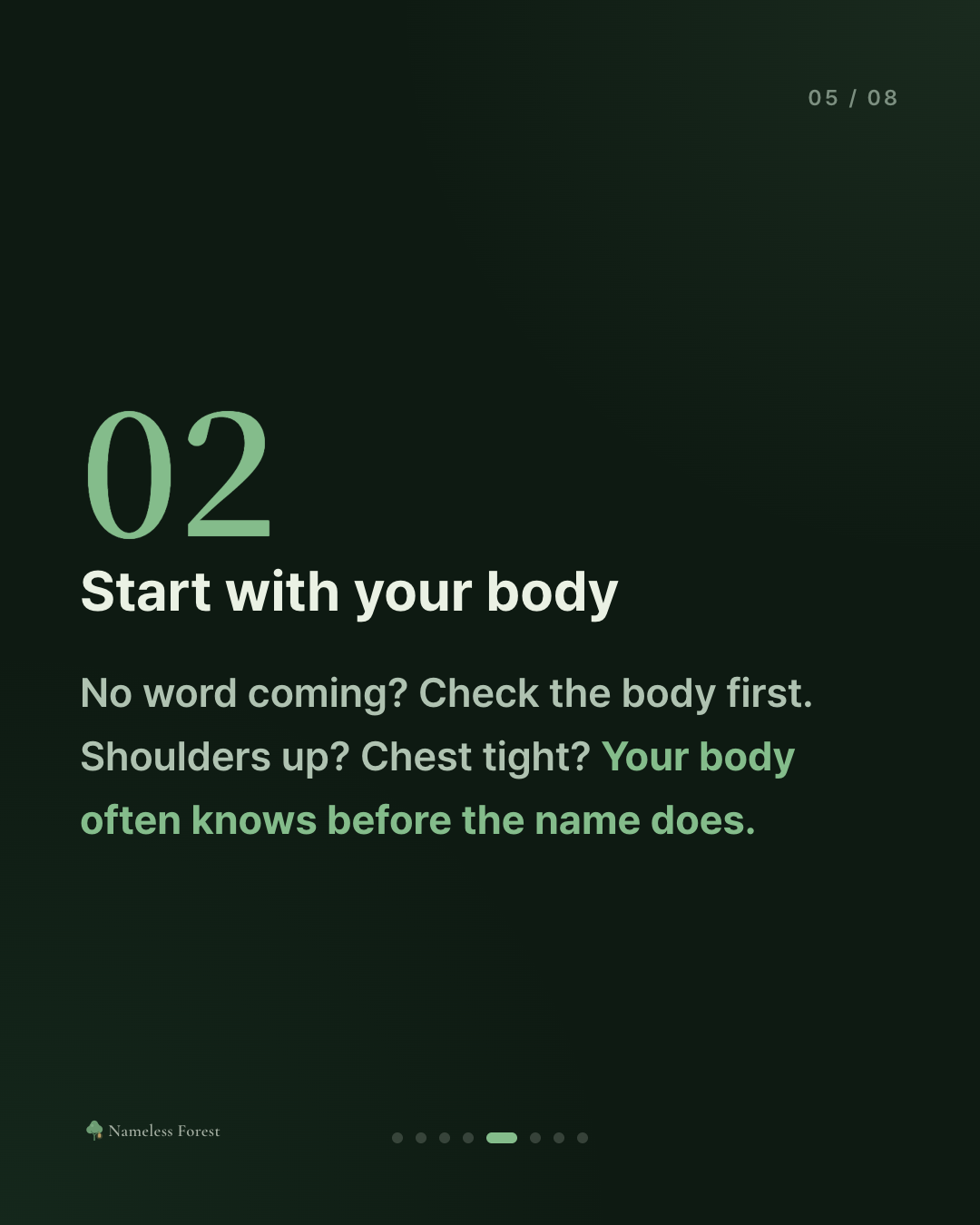
Some days no word shows up at all. On those days, skip the feeling and check the body first.
Are your shoulders up? Is your chest tight? Are you sighing a lot? For me, a tight chest usually turned out to be resentment, and raised shoulders were tension. Your body often knows before the name does.
3. If it's mixed, write both
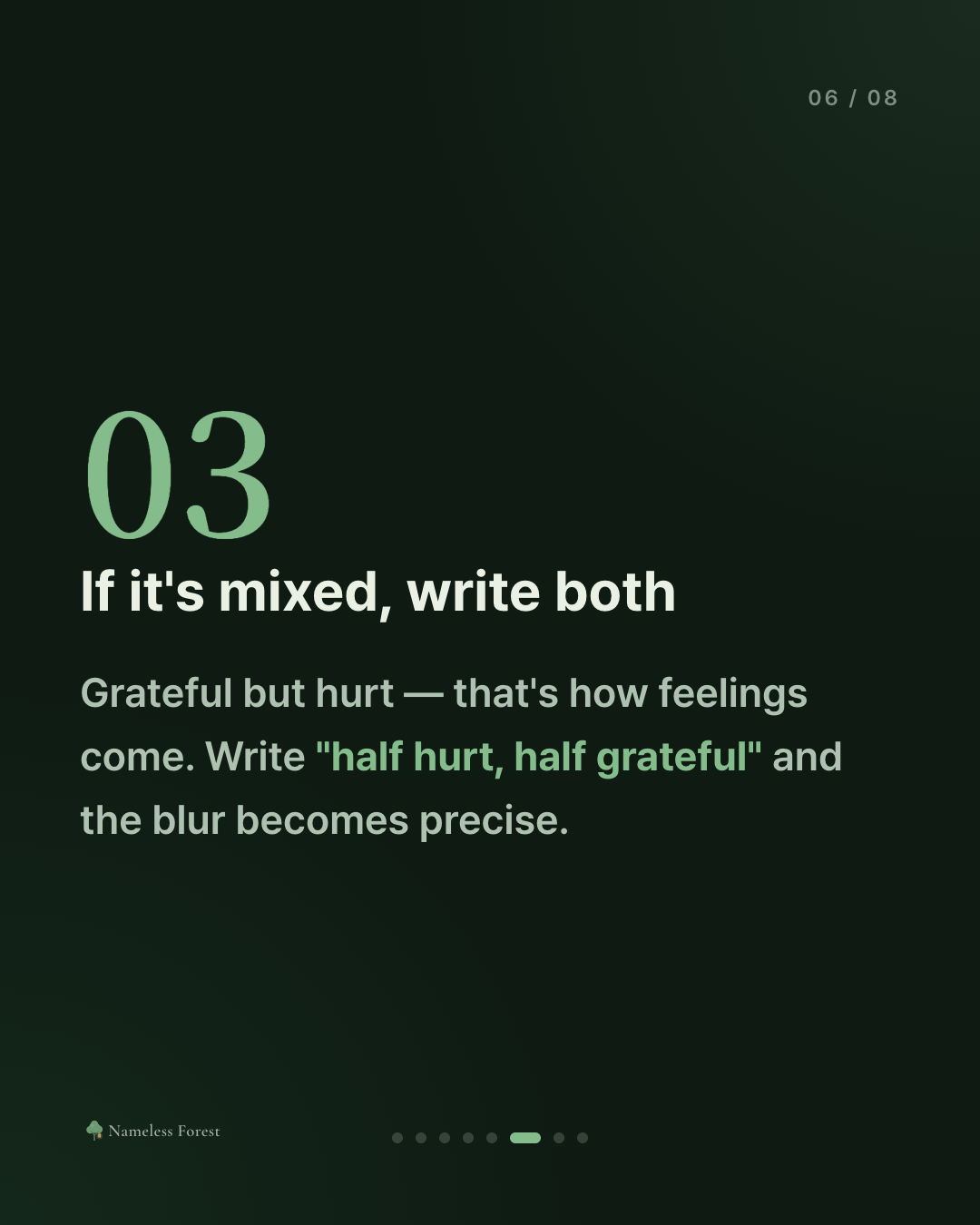
Feelings don't arrive one at a time. Grateful but hurt. Relieved but empty. If you can't pick one, don't.
"Half hurt, half grateful." Write it exactly like that. Strangely, the moment you write half-and-half, the blurry feeling becomes precise.
4. The name doesn't have to be exact
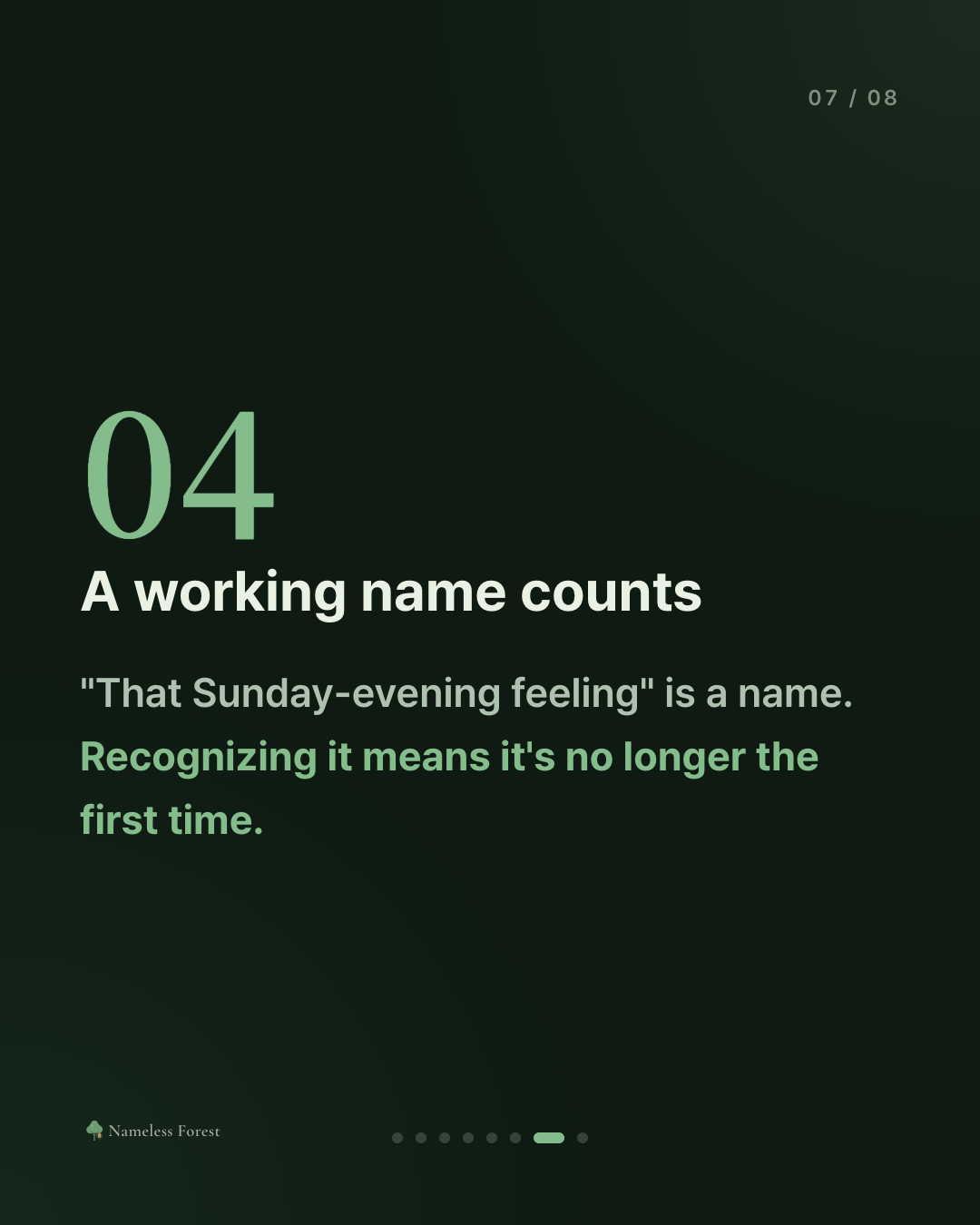
This isn't about knowing lots of emotion words. A name no dictionary has still counts, as long as you recognize it.
"That Sunday-evening feeling." "The feeling after hanging up with Mom." Give it a working name, and next time it comes, you'll recognize it. And recognizing it means it's no longer happening to you for the first time.
In short
- Things stay unsorted not because the feeling is big, but because it has no name
- The moment it's named, a feeling turns from a lump covering you into a thing you look at
- Look under the "annoyed," check your body when no word comes, write both when it's mixed
- A working name counts. All it has to do is help you recognize the feeling next time
Tonight, give whatever you're feeling one name. It doesn't have to be exact.
But sometimes this isn't enough
- If you can't sleep, or can't stop sleeping
- If eating has become hard
- If basic things — washing, cleaning — feel impossible
- If you've thought about hurting yourself
Please don't try to solve this with writing. That's when seeing a professional is the right call. A record is a tool for sorting your mind, not a treatment. (US: 988 Suicide & Crisis Lifeline.)
I'm not a mental-health professional. Just someone who's had no one to talk to.
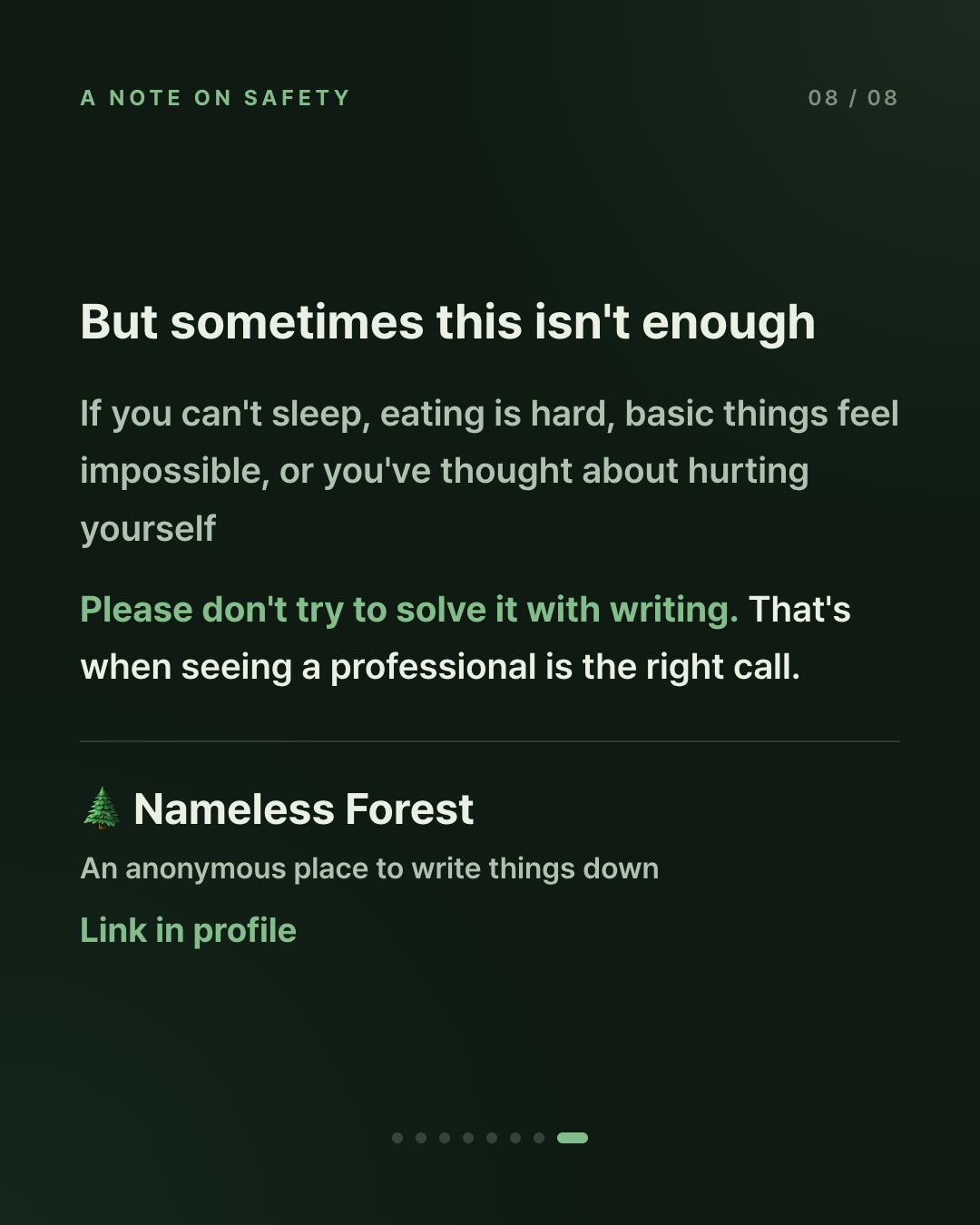
🌲 I'm building Nameless Forest — an anonymous space to write things down.
No comments, no ratings. Just a place to set it down.
A place to give today's feeling a name.
https://nameless-forest.com/en?utm_source=blognf&utm_campaign=naming-your-feelings

Comments 0
Be the first to comment.