
Have you ever opened your journal and thought: but nothing happened today?
A day that wasn't especially good or bad. You went to work, ate, came home, watched something, fell asleep. Nothing to write, so you close it again.
But look back a few days later and those are the majority. Which means most of your days end up missing from the record entirely.
"Nothing happened" is a judgment, not a fact
Let's start here. "Nothing happened" isn't a fact. It's a judgment.
We're all carrying an unspoken standard: worth writing = an event occurred. An argument. A big decision. Good news. If the day doesn't clear that bar, it gets filed as a day when nothing happened.
But a journal isn't a record of events. It's a record of states. Even with no event, there was always a state. How your body was, which way your mind was leaning — those exist regardless of whether anything happened.
Why ordinary days vanish from the record
There's a second reason. Ordinary days don't stay in memory either.
Memory stores things that have feeling attached. A day you were furious, a day you were overjoyed — those surface years later. A perfectly fine Tuesday is gone within three days.
So "nothing happened today" more precisely means not that nothing occurred, but that nothing carried enough feeling to be caught by memory. That isn't a bad thing. It means the day was calm.
But this is exactly the day writing is for
Here's where it flips. The days writing is really for are the ordinary ones.
Hard days stay with you whether or not you write them. Often they stay too well. But skip the ordinary days and, when you eventually open your record, only the bad days are in there.
Then regardless of what your life was actually like, the record makes you someone who was struggling continuously. Writing the ordinary days is what prevents that distortion.
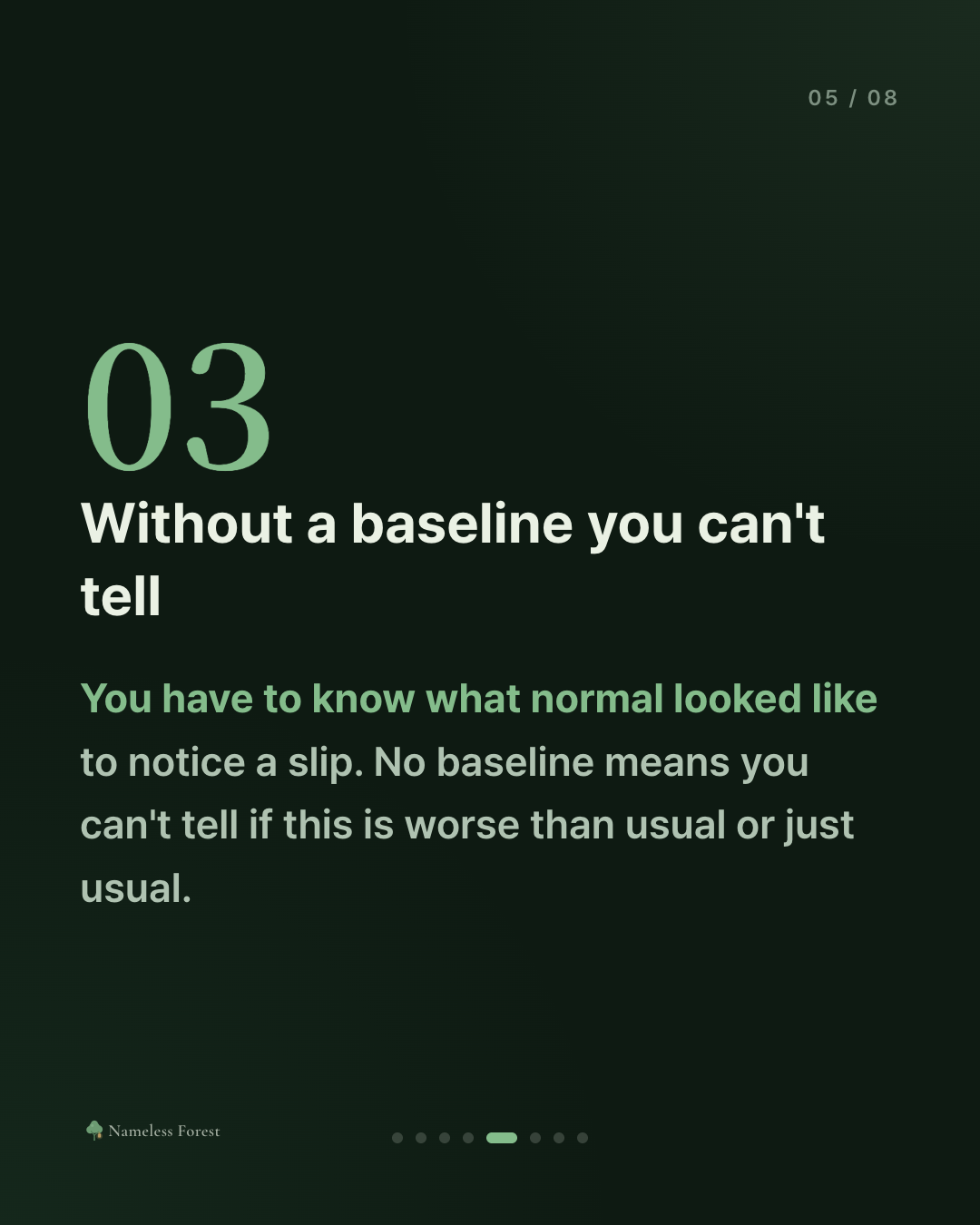
And there's something else. You have to know what normal looked like to notice when it slips. Without a baseline, you can't tell whether right now is worse than usual or simply how things are.
Leave a baseline sentence
So on an ordinary day, don't try to squeeze a feeling out of it. Write the baseline instead.
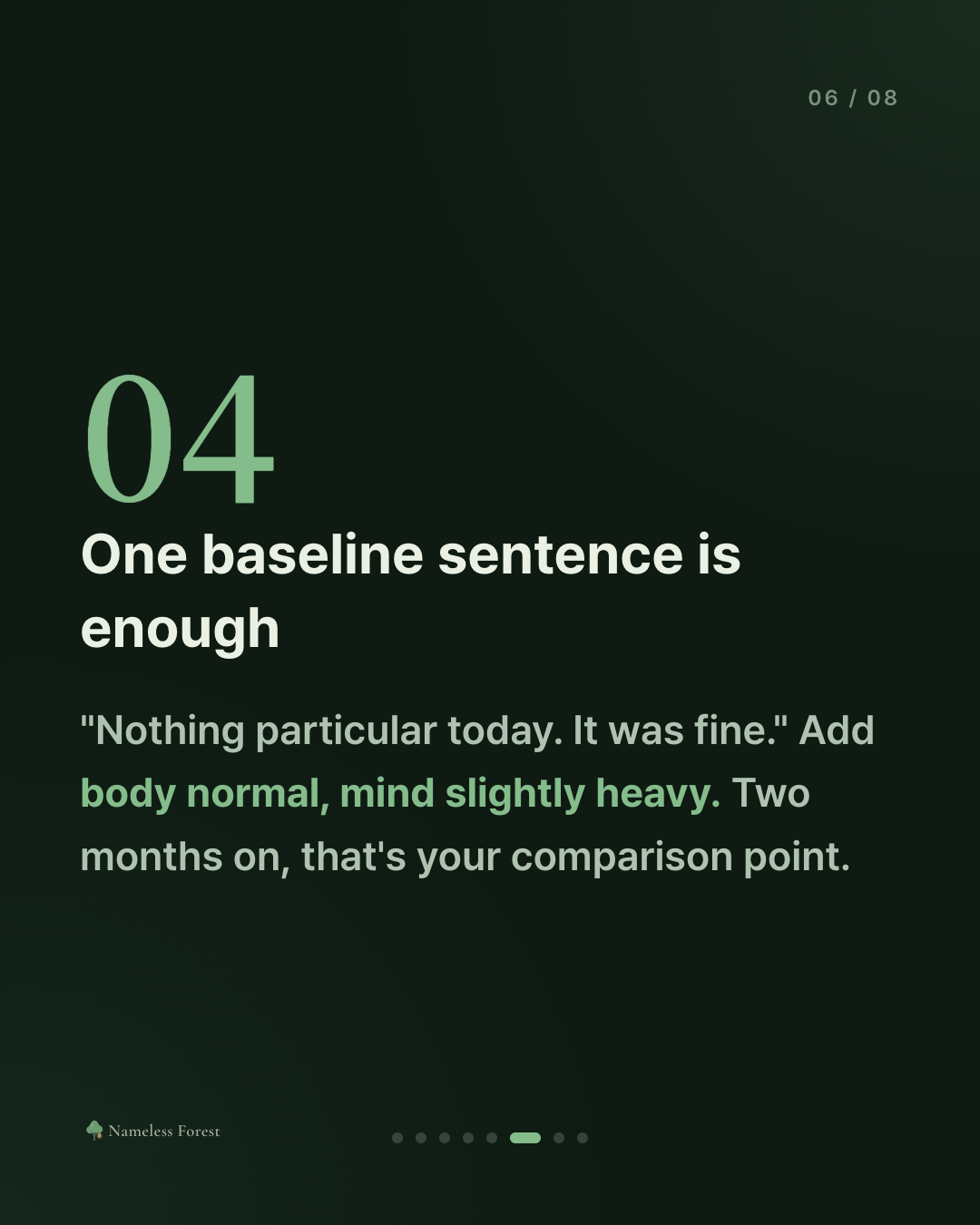
"Nothing particular today. It was fine."
That's enough. You don't have to manufacture meaning.
Adding one more line helps. Where's your body at, where's your mind at? A number works, a word works. "Body normal, mind slightly heavy" is plenty.
This becomes something to compare against later. Two months from now, on a hard day, this line tells you how far below your usual you've actually dropped.
If even that won't come, ask three things
Some days even "it was fine" won't come. On those days, don't ask about events. Ask about traces.
- What did I eat today — a real meal, or something grabbed?
- Who did I speak to today — or did I speak to nobody?
- When did time move fastest — what was I doing when it disappeared?
These are easy to answer. You don't have to excavate a memory, you just answer. Collect the three for a month and you'll see your state more accurately than any list of events. If the number of grabbed-something days is climbing, that's a signal.
In short
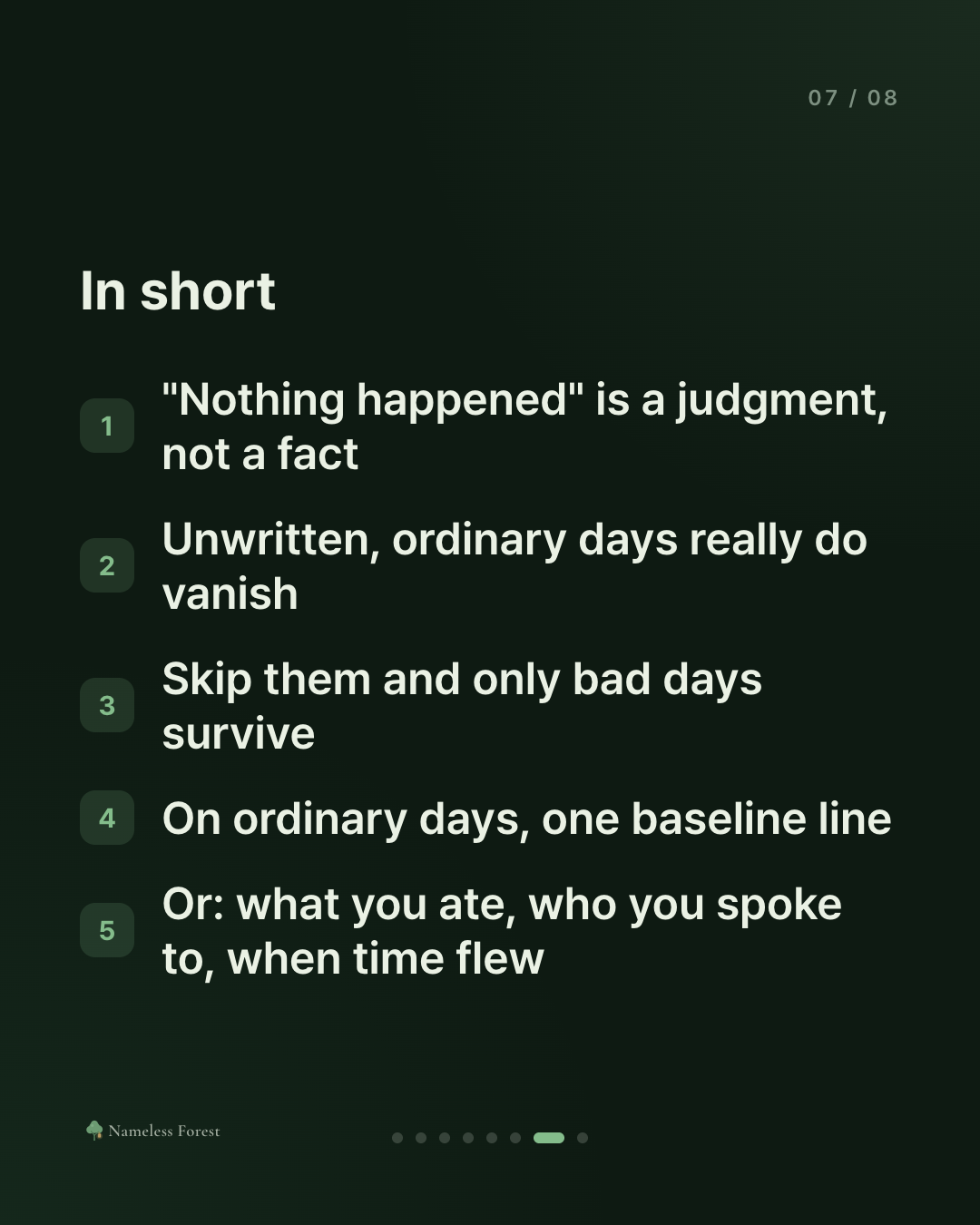
- "Nothing happened" is a judgment, not a fact. No event occurred, but a state did
- Ordinary days carry weak feeling, so memory drops them. Unwritten, they really do vanish
- Writing is most needed on ordinary days. Skip them and only bad days survive in the record
- On ordinary days, one baseline sentence plus a line on body and mind
- If even that fails: what you ate, who you spoke to, when time moved fastest
That said, sometimes this isn't enough
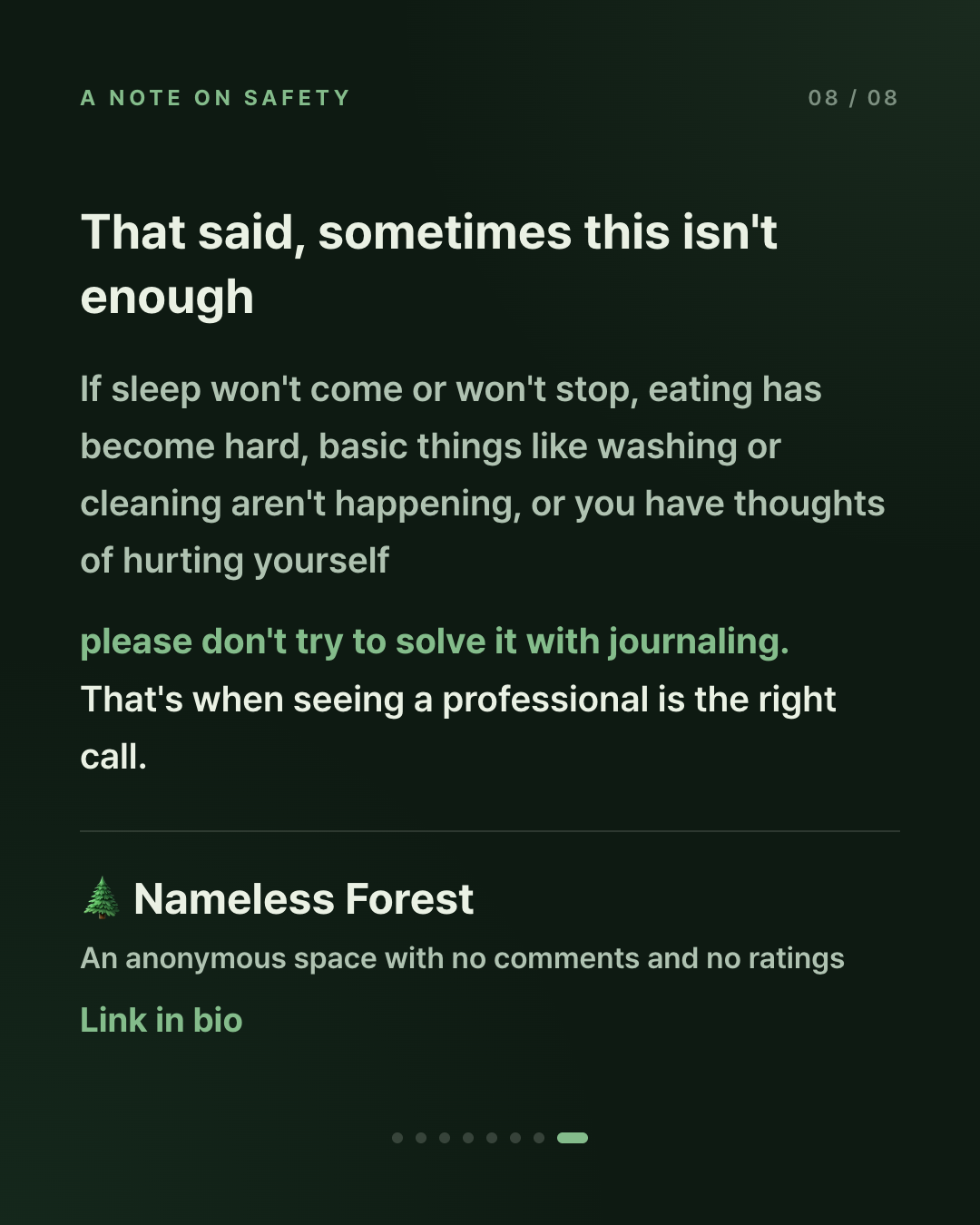
- Sleep won't come, or won't stop
- Eating has become hard
- Basic things like washing or cleaning aren't happening
- You have thoughts of hurting yourself
If you're in that state, please don't try to solve it with journaling. That's when seeing a professional is the right call. Writing is a tool for sorting your mind, not a treatment.
I'm not a mental health professional. I'm just someone who has had no one to tell.
🌲 I'm building an anonymous journaling space called Nameless Forest.
No comments, no ratings — just a place to write things down.
A place where "it was fine" is a complete entry.
https://nameless-forest.com/en?utm_source=blognf&utm_campaign=nothing-happened-today

Comments 0
Be the first to comment.