
You decided to keep an emotion journal, opened the notebook, and froze on the first line. Sound familiar?
Most people start like this:
"Today at work, my manager…"
And a few lines in, you stop. It reads back as a list of events — the feeling is nowhere in it. After about three days, you close the notebook.
I did that too. And it took me a long time to understand why.
If you start an emotion journal with "what happened," it fails.
Start from the event and you slip into explanation mode. Who did what, why it was unfair, how you should have responded. That's not writing a feeling — that's writing a court record. No wonder you don't feel any lighter when you're done.
1. Start from the body
A feeling reaches the body before the head. So if you start the first line here, it comes much more easily:
"What is my body doing right now?"
- Are my shoulders up
- Is my jaw clenched
- Is my chest tight
- Is my breathing shallow
- Or is there no strength anywhere
No thinking required. Just observe and write. And strangely, once you've written the body, the name of the feeling follows on its own.
"My chest is blocked. My breath is short." → Ah — I'm anxious.
Just by changing the order, you don't freeze on the first line.
2. Don't write "annoyed"
The word that shows up most in emotion journals is *annoyed*. But annoyed isn't the name of a feeling — it's more like a lid over several feelings at once.
Lift it one layer. You wrote "annoyed," but really it was —
- Dismissed — my words didn't land
- Wronged — I'm the only one carrying this
- Anxious — this feels like it's going to go bad
- Worn out — I just can't anymore
- Hurt — I thought they'd understand
Same situation, but what you need is completely different depending on which. If you were dismissed, you speak up. If you're worn out, you sleep.
Just naming it accurately decides the next move. Most of the real use of an emotion journal comes from here.
3. Three lines is plenty
Try to write long, and you won't write at all. Fix the form like this:
1. Body : what is my body doing
2. Name : the name of this feeling
3. One line : so, what I want to say right now
An example:
1. Body: shoulders stiff, keep sighing.
2. Name: thought it was annoyance, it's hurt.
3. One line: I wanted the effort to be seen.
That's it. Thirty seconds. And because it's a thirty-second thing, you write it again tomorrow.
4. Don't write it nicely
Here's the second thing that collapses an emotion journal. No one's going to read it, yet you polish the sentence. Fix the spelling. Then it gets tiresome, and you stop.
- Broken grammar is fine
- Swearing is fine
- No conclusion is fine
- Ending on "I don't know" is fine
An emotion journal isn't a piece of writing — it's an outlet. The moment you tidy it, the outflow stops.
5. You don't have to read it back
Lots of advice says "read it back and reflect." I'll say the opposite.
If you think you have to read it back, you won't write. The moment you picture a later self reading it, you start writing it nicely again.
The thing already happens in the act of writing. A blurry feeling becomes a sentence, takes a shape — and once it has a shape, it's smaller than you. That's enough. You don't have to read it back.
6. On days you can't, one line
The vow to write *every day* is what kills an emotion journal. On days you can't, just write this:
"I don't want to write anything today."
That's a record too. And the day you write that one line, you're far more likely to write again tomorrow than the day you skipped entirely.
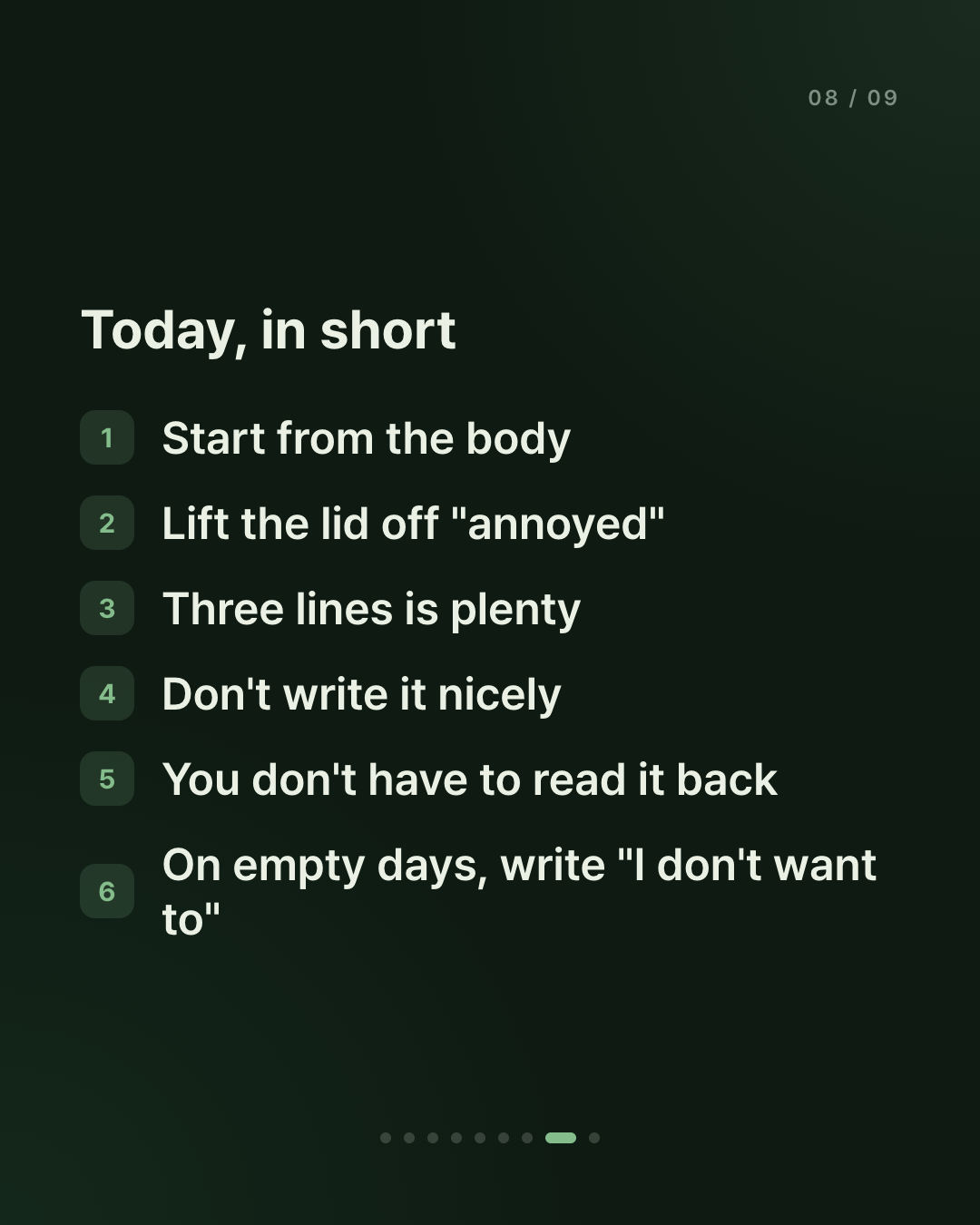
In short
- Start from the body — start from the event and it becomes a court record
- Lift the lid off "annoyed" — the accurate name decides the next move
- Three lines is plenty — a thirty-second thing gets written tomorrow too
- Don't write it nicely — tidy it and the outflow stops
- You don't have to read it back — it already happened in the writing
- On days you can't, write "I don't want to write"
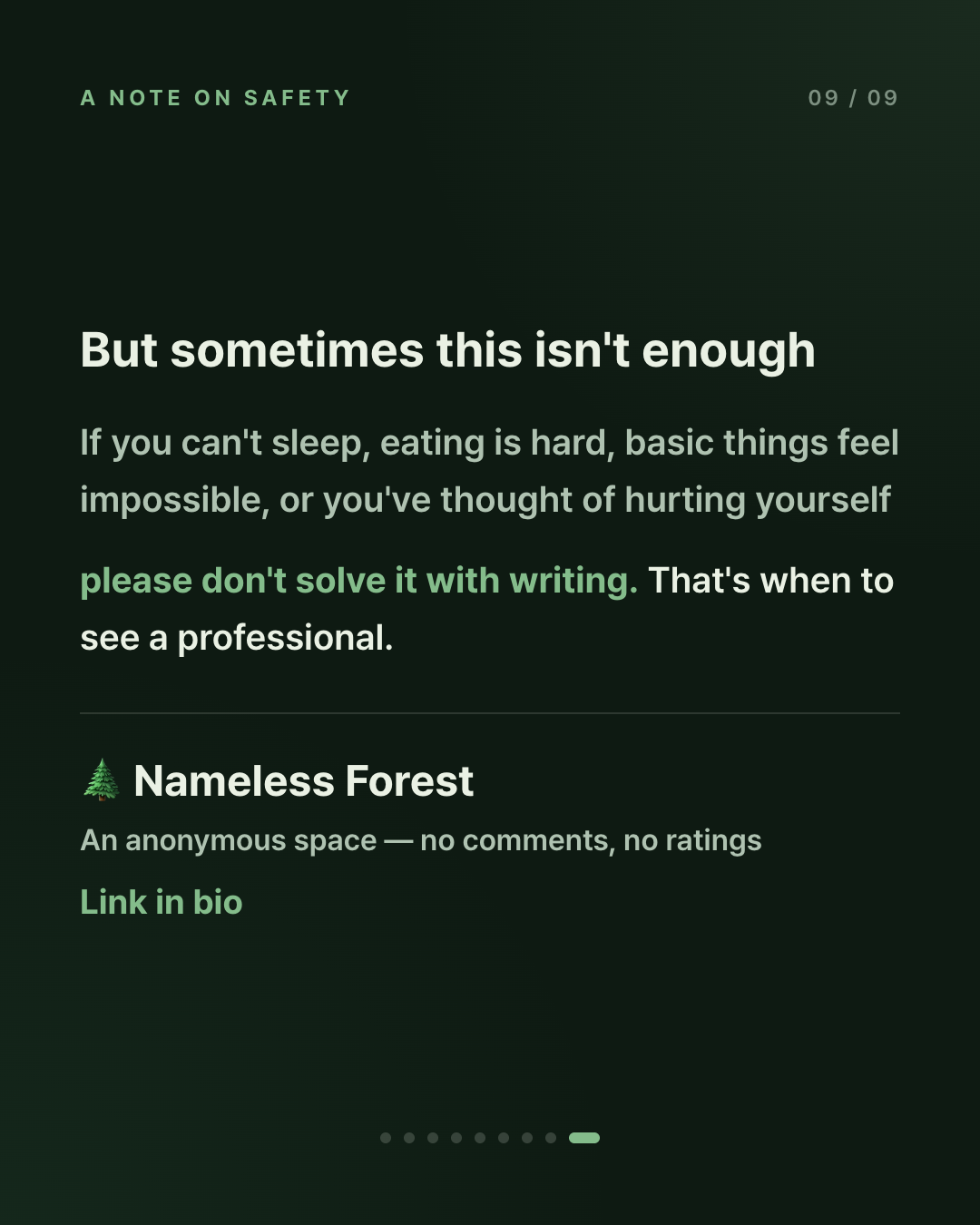
But sometimes this isn't enough
- If you can't sleep, or can't stop sleeping
- If eating has become hard
- If basic things — washing, cleaning — feel impossible
- If you've thought about hurting yourself
Please don't try to solve this with writing. That's when seeing a professional is the right call. A record is a tool for sorting your mind, not a treatment. (US: 988 Suicide & Crisis Lifeline.)
I'm not a mental-health professional. The methods above are just what was left after I tried them myself — nothing more.
🌲 I'm building Nameless Forest — an anonymous space to write things down.
No comments, no ratings. Just a place to set it down.
https://nameless-forest.com/en?utm_source=blognf&utm_campaign=journal-howto

Comments 0
Be the first to comment.